
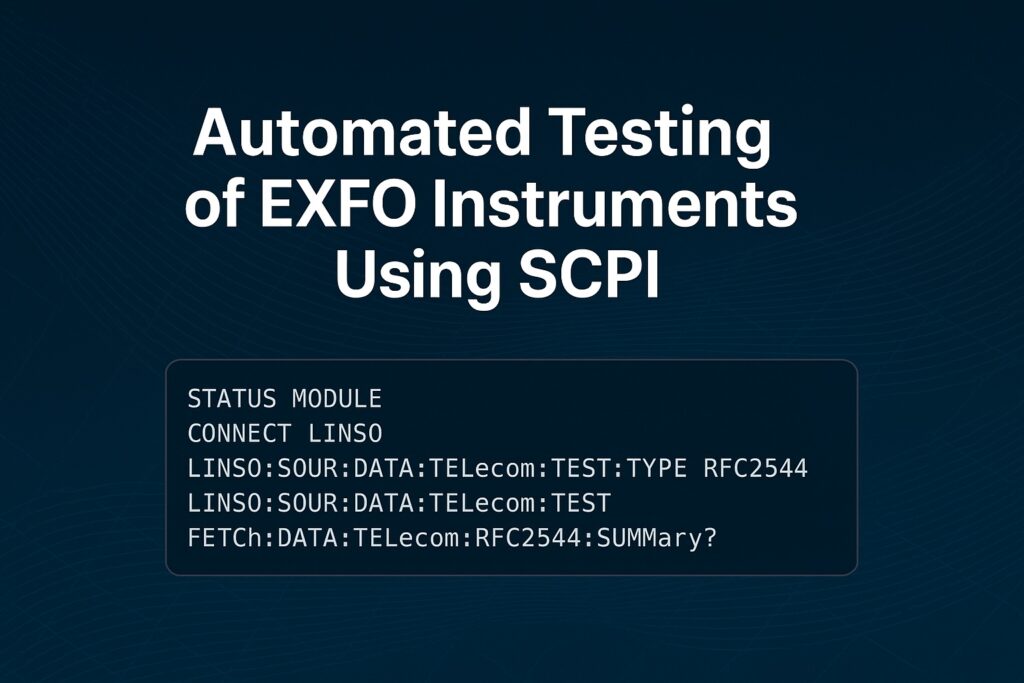
In today’s fast-paced world of telecom, datacom, and optical network testing, automation is no longer a luxury — it’s essential. If you’re using EXFO instruments like the NetBlazer, Power Blazer, or iOLM modules, mastering SCPI (Standard Commands for Programmable Instruments) can save you countless hours and unlock powerful test workflows.
Related Contents
- Building a Lightweight EXFO Tester Admin Panel with FastAPI and Alpine.js
- Streamline Fiber Tester Management with a Lightweight EXFO Admin Panel
In this blog post, we’ll dive into:
- What SCPI is
- How EXFO instruments use SCPI
- Key SCPI commands for EXFO
- How to build simple Python scripts to automate your testing
Let’s get started!
🌟 What is SCPI?
SCPI (pronounced "skippy") is an industry-standard language for controlling test instruments. It’s a set of human-readable text commands that allow you to remotely:
- Configure settings
- Start and stop measurements
- Fetch test results
- Handle errors and statuses
If you’ve ever typed *IDN? to query a device’s identity, you’ve used SCPI!
📊 How EXFO Instruments Use SCPI
EXFO platforms like the FTB-1 Pro, FTB-2 Pro, and FTB-4 Pro, along with modular instruments like the FTBx-88480 (Power Blazer) or FTBx-8880 (NetBlazer), support SCPI over TCP/IP or Telnet sessions.
Each inserted module (called a "slot") is addressed logically using a LINSx ID, like LINS0, LINS2, etc. This allows you to direct SCPI commands specifically to the correct module, even if multiple instruments are present.
Before sending any commands, you should:
- Discover available modules using
STATUS MODULE - Connect to the desired LINS if needed using
CONNECT LINSx
🌐 Basic SCPI Commands for EXFO
Here are some of the most important SCPI commands you need to know:
| Command | Purpose |
|---|---|
*IDN? |
Query the instrument identification |
*RST |
Reset the module to factory default settings |
*CLS |
Clear the event and error queues |
STATUS MODULE |
List all available modules and their LINS IDs |
CONNECT LINSx |
Connect to a specific module |
LINSx:SOUR:DATA:TELecom:TEST:TYPE RFC2544 |
Configure a test type |
LINSx:SOUR:DATA:TELecom:TEST |
Start the test |
LINSx:SOUR:DATA:TELecom:TEST:STOP |
Stop a running test |
FETCh:DATA:TELecom:RFC2544:SUMMary? |
Fetch RFC 2544 summary results |
These basic commands let you fully automate test cycles from initialization to result collection.
🚀 Simple Python Automation Example
Controlling EXFO devices from Python is easy using raw TCP sockets. Here’s a basic example:
import socket

def send_scpi_command(command):
    ip = "192.168.1.100"
    port = 5025
    with socket.socket(socket.AF_INET, socket.SOCK_STREAM) as s:
        s.connect((ip, port))
        s.sendall((command + "\r\n").encode())
        response = s.recv(4096).decode()
        return response.strip()

# Example usage
print(send_scpi_command("*IDN?"))
print(send_scpi_command("STATUS MODULE"))
For production-grade scripts, you’d want to handle timeouts, retries, and errors more gracefully, but this gives you a functional starting point.
🎓 Pro Tips for SCPI with EXFO
- Always use
STATUS MODULEbefore sending commands to ensure your LINS exists. - Use
*CLSbefore starting new tests to avoid unexpected errors. - After starting a test, poll
LINSx:SOUR:DATA:TELecom:TEST?until it reports "COMPLETED" before fetching results. - Handle error messages like "Index out of bounds" carefully — it usually means you sent a command to a non-existent object.
🌍 Conclusion
SCPI opens the door to powerful automation with EXFO’s field-proven instruments. Whether you’re validating metro Ethernet networks, mobile backhaul links, or datacenter fiber, automating your test setups can drastically improve efficiency and consistency.
Mastering just a handful of SCPI commands gives you full control over test configuration, execution, and reporting.
Stay tuned for the next post where we’ll build a complete Python SCPI test controller for EXFO platforms!
Happy testing! 🚀
Latest Posts
- Why AI Agents Stall in Southeast Asian Enterprises, and the Trust Layer That Gets Them Live October 15, 2026
- Which Product Should a Creator Promote? An Idea We Want to Test October 14, 2026
- A Local LLM in a Factory, With Nothing Leaving the Building October 13, 2026
- Japan’s Active Cyber Defense Law Is Live: What Suppliers to Critical-Infrastructure Operators Should Have Ready in the First 30 Days October 13, 2026
- Find a Subaru Service Shop in Thailand: A Small Tool That Shows Where Each Detail Came From October 12, 2026
- simpliRange Is Live in Early Form: Try the EV Road-Trip Planner Built for Thai Roads and Tell Us Where It’s Wrong October 8, 2026