
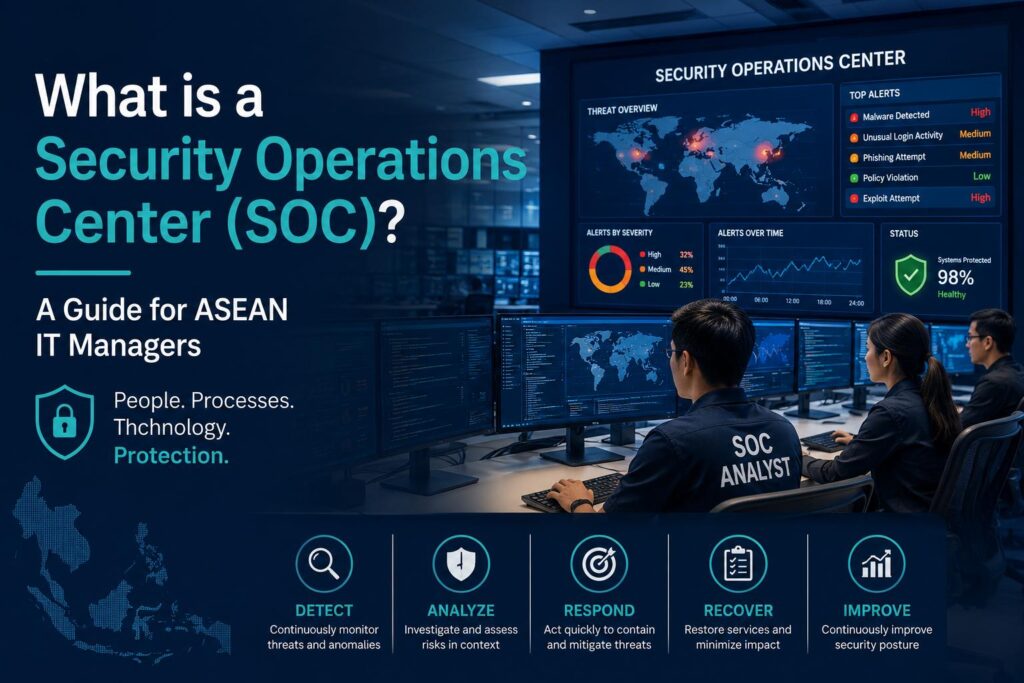
Every week, another headline: a hospital hit by ransomware, a manufacturer’s production data exfiltrated, a government agency’s email system compromised. The attacks are not slowing down. But most organizations in Southeast Asia still have no systematic way to detect, investigate, or respond to them.
A Security Operations Center — SOC — is the answer to that gap. This guide explains what a SOC is, what it does day-to-day, and how organizations in Thailand and ASEAN can get SOC-level protection without building a team from scratch.
The One-Sentence Definition
A Security Operations Center (SOC) is the team, technology, and process responsible for monitoring an organization’s IT environment 24/7, detecting threats, and responding to security incidents before they become breaches.
Think of it as a security nerve center: every log, every alert, every anomaly from every system in your organization flows into the SOC, where analysts and automated tools triage it and decide what to do.
What Problem Does a SOC Solve?
Most organizations generate enormous volumes of security events every day — firewall blocks, failed logins, unusual network connections, endpoint alerts. The problem is not a lack of data. The problem is:
- Volume — Tens of thousands of events per day. No human can review them manually.
- Context — A single failed login is noise. Five hundred failed logins from one IP at 3am is an attack. Connecting those dots requires correlation across systems.
- Speed — The average attacker moves from initial access to data exfiltration in under 24 hours. Detection that takes days is useless.
- Expertise — Distinguishing a real threat from a misconfigured server requires specialized knowledge most IT generalists do not have.
A SOC solves all four. It aggregates data from every source, applies correlation rules, uses automation to filter noise, and surfaces real threats to analysts who know what to do with them.
What Does a SOC Actually Do?
Continuous Monitoring
The SOC ingests logs from every relevant source — firewalls, endpoints, servers, VPNs, identity systems, cloud platforms — and monitors them around the clock. No gaps, no weekends, no holidays.
Alert Triage
Not every alert is a real threat. The SOC applies rules, threat intelligence, and context to classify alerts: genuine incident, false positive, or needs further investigation. Automation handles the bulk of this at Tier 1.
Threat Detection
Beyond rule-based alerts, modern SOCs use behavioral analytics to detect anomalies — a user account suddenly accessing file shares it never touched before, a server making outbound connections to an unusual country, a process running in memory with no corresponding executable on disk.
Incident Response
When a real incident is confirmed, the SOC follows a defined playbook: contain the affected system, collect forensic evidence, eradicate the threat, recover operations, and document the full incident timeline.
Threat Intelligence
SOCs continuously update their detection rules with fresh threat intelligence — new malware signatures, attacker infrastructure (IPs, domains), and tactics from recent incidents globally. This is how the SOC stays ahead of evolving attack patterns.
Reporting and Compliance
Every incident is documented. The SOC produces regular reports on security posture, incident trends, and compliance status — essential for PDPA obligations, ISO 27001 audits, and board-level risk reporting.
The SOC Technology Stack
A modern SOC runs on several integrated platforms:
flowchart TD
  A["Log Sources"] --> B["SIEM"]
  A --> C["Firewalls and Network"]
  A --> D["Endpoints and Servers"]
  A --> E["Identity and VPN"]
  A --> F["Cloud Platforms"]
  B --> G["Alert Engine"]
  G --> H["SOAR Automation"]
  H --> I["Incident Response Platform"]
  I --> J["SOC Analyst"]
  K["Threat Intelligence"] --> B
  K --> G
SIEM (Security Information and Event Management): The central log aggregation and correlation engine. Receives logs from all sources, applies detection rules, and generates alerts. simpliSOC uses Wazuh — open-source and production-ready.
SOAR (Security Orchestration, Automation and Response): Automates repetitive response actions — blocking an IP, isolating a host, enriching an alert with threat intelligence — without requiring a human analyst for every step. simpliSOC uses Shuffle for this layer.
Incident Response Platform (IRP): The case management system where analysts track investigations, record evidence, and document response actions. simpliSOC uses DFIR-IRIS for this layer.
Threat Intelligence Feed: External data sources that tell the SIEM what known-bad IPs, domains, and file hashes to watch for.
Three Ways to Get SOC Coverage
Organizations have three main options:
Option 1: Build an In-House SOC
Stand up your own SIEM, hire SOC analysts (Tier 1, 2, 3), build detection rules, maintain threat intelligence subscriptions, and run 24/7 shifts.
Reality check for most ASEAN organizations: The cybersecurity talent shortage across Southeast Asia is severe. Building a true 24/7 in-house SOC requires a minimum of 6–8 analysts (to cover shifts with redundancy), a CISO to lead them, and significant tool licensing costs. Annual cost: USD 500,000+ before infrastructure.
Option 2: Managed Detection and Response (MDR) / MSSP
Outsource the entire SOC function to a third-party provider. They supply the analysts, tools, and 24/7 coverage. You get alerts and monthly reports.
Advantage: Fast to deploy, no hiring required.
Disadvantage: Your data leaves your environment. Detection rules are generic, not tuned to your specific infrastructure. Response actions often require your approval, slowing containment.
Option 3: Open-Source SOC Stack (Deployed On-Premise)
Deploy a production-ready SOC stack built entirely from open-source components — Wazuh as the SIEM, DFIR-IRIS for incident management, Shuffle for SOAR automation — on your own infrastructure, with a specialist integrator managing the custom logic.
This is the simpliSOC model. Your data never leaves your environment. Detection rules are tuned to your specific systems. The integrator layer (our custom FastAPI service) handles correlation, deduplication, and automated enrichment.
Cost: a fraction of commercial SIEM licensing, with full data sovereignty.
What simpliSOC Monitors
flowchart TD
  A["simpliSOC"] --> B["Endpoint Telemetry"]
  B --> C["Sysmon: process creation"]
  B --> D["Sysmon: network connections"]
  B --> E["Registry changes"]
  A --> F["Network and Perimeter"]
  F --> G["Firewall allow/deny logs"]
  F --> H["VPN authentication"]
  F --> I["DNS query logs"]
  A --> J["Identity and Access"]
  J --> K["Active Directory logon events"]
  J --> L["Privilege escalation"]
  J --> M["Account lockouts"]
  A --> N["Log-Loss Alerting"]
  N --> O["Alert if no events within threshold"]
A feature most organizations overlook: log-loss alerting. If a monitored system stops sending logs — because an attacker disabled the agent, or a network outage broke the connection — simpliSOC alerts immediately. Silent failures are caught before they create blind spots.
SOC Maturity: Where Does Your Organization Stand?
Most organizations start at Level 1 and build from there:
| Level | Capability | Typical State |
|---|---|---|
| 0 | No monitoring | Rely on vendor alerts and user reports |
| 1 | Basic log collection | SIEM installed, default rules only, no 24/7 coverage |
| 2 | Alert triage | Analysts reviewing alerts during business hours |
| 3 | Active monitoring | 24/7 coverage, custom detection rules, threat intelligence |
| 4 | Threat hunting | Proactive searches for attacker presence, not just alert response |
| 5 | Automated response | SOAR handling containment autonomously, analysts focus on investigation |
Most ASEAN mid-market organizations are at Level 0 or 1. simpliSOC targets Level 3–4 from day one, with Level 5 automation built into the SOAR layer.
SOC and Compliance in Thailand and ASEAN
If you operate in Thailand, you have specific obligations that a SOC directly addresses:
PDPA (Personal Data Protection Act): Requires organizations to detect and notify the PDPA Office of data breaches within 72 hours of becoming aware. Without a SOC, you will not become aware in time.
Thai Cybersecurity Act B.E. 2562: Operators of critical information infrastructure (energy, finance, health, telecoms, transport, public administration) are legally required to implement security monitoring and incident response procedures.
ISO 27001: SOC operations map directly to ISO 27001 Annex A controls — particularly A.12 (Operations Security) and A.16 (Incident Management). A functioning SOC significantly accelerates ISO 27001 certification.
For Japanese-owned operations in Thailand, NISC guidelines and the Economic Security Promotion Act add further requirements around supply chain security monitoring that a properly configured SOC satisfies.
Frequently Asked Questions
Does a small organization need a SOC?
If you handle customer data, process payments, or operate production systems — yes. Attack volume does not scale with company size. Ransomware operators target SMEs specifically because they have less security capability than large enterprises.
How is a SOC different from antivirus software?
Antivirus runs on individual endpoints and catches known malware signatures. A SOC monitors behavior across your entire environment and detects attacks that bypass endpoint tools — credential theft, lateral movement, living-off-the-land attacks that use legitimate Windows tools.
What logs does a SOC need to be effective?
At minimum: firewall logs, Windows event logs (with Sysmon), and authentication logs from your identity provider. Progressively adding VPN, DNS, and cloud platform logs increases detection coverage significantly.
How long does it take to deploy simpliSOC?
The core stack deploys in under a day via Docker Compose. Tuning detection rules to your specific environment and integrating all log sources typically takes 2–4 weeks to reach production quality.
What happens when simpliSOC detects a threat?
Depending on severity: automated containment actions via Shuffle SOAR (blocking IPs, isolating hosts), an alert to your team via Slack, LINE, or PagerDuty, and an incident case created automatically in DFIR-IRIS for analyst investigation.
Summary
A Security Operations Center is not a luxury for large enterprises. It is the minimum viable security posture for any organization that stores data, runs production systems, or operates in a regulated industry.
The question is not whether to have SOC-level coverage. The question is whether to build it in-house (expensive, slow), buy it from a large MSSP (high cost, low customization), or deploy an open-source stack that gives you enterprise-grade detection at a fraction of the cost — with full data sovereignty.
That is what simpliSOC is built to do.
Want to see what simpliSOC would monitor in your environment?
Book a free security assessment → hello@simplico.net
Latest Posts
- A local LLM for CNC and mold shops: what it is good for, what it should not touch, and what to test first October 24, 2026
- Dive centres and tour operators: when LINE chats and spreadsheets stop working as your booking system October 24, 2026
- E-invoicing in Vietnam and Malaysia: what your POS or ERP has to do before the penalties start October 22, 2026
- CBAM for suppliers: what your EU buyer will ask you for, and the data to start collecting now October 22, 2026
- Scoping an EV Charging Platform for a Large Property Owner: Two Driver Apps, a Prepaid Wallet and Three Levels of Trust October 20, 2026
- The Site Host Problem: Giving a Condo, Hotel or Restaurant Its Own Charger Dashboard Without Another Account to Manage October 17, 2026