Ask a plant manager why the ERP project has been "under evaluation" for two years, and you’ll rarely hear that the software is wrong. You’ll hear something closer to: we can’t afford for this to go badly.
Read More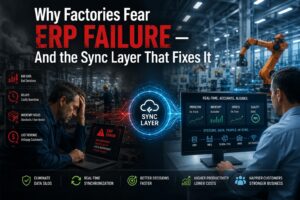

Ask a plant manager why the ERP project has been "under evaluation" for two years, and you’ll rarely hear that the software is wrong. You’ll hear something closer to: we can’t afford for this to go badly.
Read More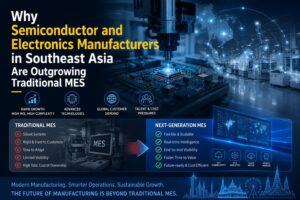
Southeast Asia’s semiconductor and advanced-electronics manufacturing base is expanding faster than most factory software was designed to handle. Thailand already produces the majority of the world’s hard disk drives and is pushing further into automotive electronics.
Read More
Not literally. But consider what happens when your biggest customer calls with a complaint about a batch you shipped six weeks ago.
Read More
Choosing the wrong technology partner is an expensive mistake — and in Southeast Asia, the risk is compounded by regulatory fragmentation, uneven technical depth, and the reality that many vendors sell regionally but deliver locally with a skeleton crew.
Read More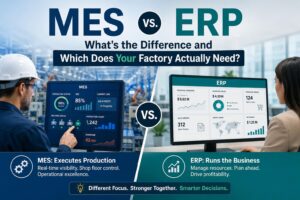
If you run a factory and someone tells you "just get an ERP," you’ve probably wondered whether that’s the whole story. And if you’ve heard of MES but aren’t sure how it’s different from SAP or Oracle — this guide is for you.
Read More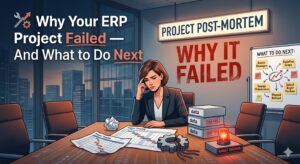
For factory owners who invested millions, waited years, and still don’t have a system that works. You didn’t fail. The project failed you.
Read More
Most custom ERP projects don’t fail because the platform was too weak. They fail because the team used the wrong layer of it — and discovered the ceiling six months in, after the budget was spent and the business had already reshaped itself around the half-built system.
Read More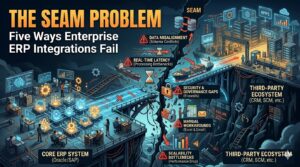
There’s a sentence we hear at the kickoff of every ERP integration rescue: "It worked perfectly in UAT."
Read More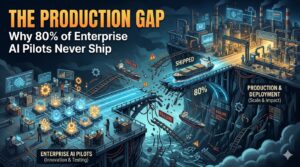
There’s a graveyard somewhere in every enterprise IT department. It’s full of demos that wowed a steering committee in 2024, RAG prototypes that beat ChatGPT on three cherry-picked questions, and copilots that looked unstoppable in a sandbox. Then someone asked the hard question — can we put this in front of 4,000 employees, integrated with […]
Read More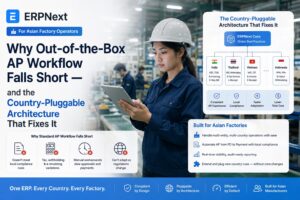
If you’re running ERPNext across multiple Asian factory operations — say a manufacturing plant in India, a Southeast Asian satellite (Thailand, Vietnam, Indonesia), and an export-oriented Chinese subsidiary — you’ve probably noticed the same pattern in three different forms. ERPNext handles the manufacturing operations beautifully. The Manufacturing module, the BOM/work order/subcontracting flow, the multi-warehouse stock […]
Read More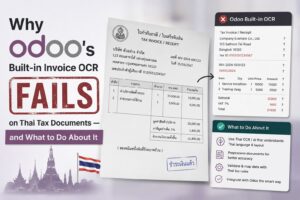
If you run Odoo across multiple Asian markets — say, a manufacturing operation in Thailand, a sales subsidiary in Japan, and a procurement office in China — you’ve probably discovered the same thing in three different ways. The standard invoice digitization feature works beautifully on the AWS bills and the European supplier invoices. It struggles, […]
Read More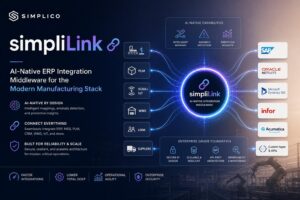
Enterprise ERP integration is a solved problem — at least, that’s what your SI vendor will tell you. The reality inside tier-2 and tier-3 manufacturing plants is very different: brittle point-to-point connectors, hand-rolled ABAP scripts, and decades-old middleware that breaks every time a vendor pushes a schema update. The data exists. The systems exist. The […]
Read More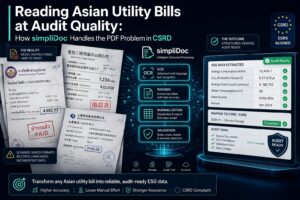
The data source nobody wants to talk about Walk into the General Affairs department of a Japanese, Thai, or Chinese factory and ask where last month’s electricity consumption data is. You will not be directed to a system. You will be directed to a folder — physical or digital — containing PDFs from the local […]
Read More
The first time a Japanese, Thai, or Chinese conglomerate’s CFO sees a Big 4 CSRD readiness proposal, the reaction is some variant of disbelief. €2–4M for the first year. €400–900K ongoing. Hourly rates that translate to JPY 60,000–100,000, RMB 3,000–5,000, or THB 13,000–22,000 per hour. The proposal arrives with a Gantt chart, a stakeholder map, […]
Read More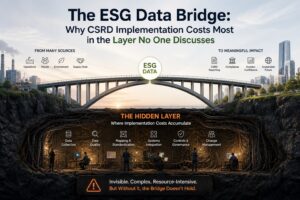
The €5M quote and the wrong line item A pattern we keep seeing. A Japanese, Korean, or Thai conglomerate gets the letter — or rather, the internal memo — confirming that one of their EU subsidiaries crosses the CSRD threshold. Net turnover above €50M, more than 250 employees, listed or large enough that the Omnibus […]
Read More
Walk into any mid-sized accounting firm in Bangkok and you’ll see the same thing. Three monitors. One has FlowAccount open — logged in as the client. Another has Excel — the master tracker, color-coded by partner, deadline, and filing type. The third has LINE — twelve group chats, one per client, full of photographed receipts, […]
Read More
title: "Why Your Finance Team Spends 40% of Their Week on Work AI Can Now Do" For CFOs and COOs of mid-market Thai manufacturers and distributors If you run finance or operations at a 100 to 500 person manufacturer or distributor in Thailand, you already know the shape of the problem. Your team is technically […]
Read More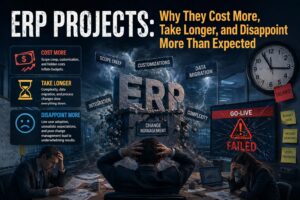
Every year, companies across Thailand, Japan, and Southeast Asia invest millions into ERP systems expecting streamlined operations, real-time visibility, and long-term cost savings. Many get the opposite.
Read More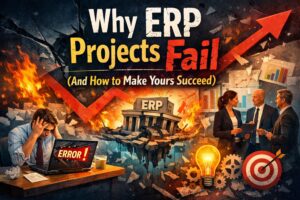
Every year, enterprises pour millions of dollars into ERP implementations — and a striking number of them go over budget, miss deadlines, or get abandoned entirely. The Standish Group has tracked this problem for decades, and the pattern is consistent: ERP projects fail not because the software is bad, but because the surrounding decisions are.
Read More