Most RAG demos work. Most RAG production deployments fail — quietly, expensively, and in ways that are hard to debug.
Read More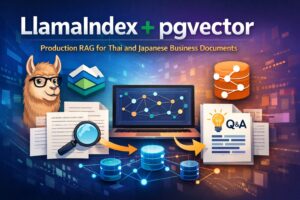

Most RAG demos work. Most RAG production deployments fail — quietly, expensively, and in ways that are hard to debug.
Read More
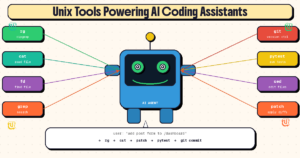
What Tools Do AI Coding Assistants Actually Use? How Claude Code, Codex CLI, and Aider read files, search codebases, run tests, and commit code — under the hood AI coding assistants feel like magic. You type "add a login form to the dashboard," and the tool finds the right files, writes the component, checks that […]
Read More
Introduction Many companies depend on software systems that nobody fully understands anymore. The original developers may have left, documentation may be outdated, and the system has evolved through years of patches and quick fixes. Yet these systems often run critical operations such as finance, logistics, manufacturing, or customer management.
Read More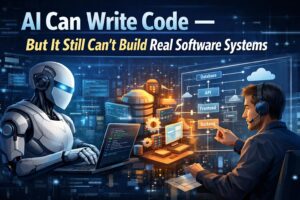
"AI can generate code. But it cannot generate trust, context, or consequence." The rise of AI coding assistants has sparked a familiar panic: Will developers become obsolete? The honest answer is — some tasks will. Boilerplate generation, unit test scaffolding, basic CRUD APIs. These are fair game.
Read More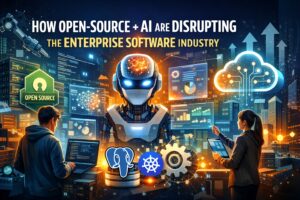
Introduction For decades, large enterprises relied on massive proprietary software systems. These platforms promised reliability, scalability, and support—but they often came with extremely high costs, long implementation timelines, and vendor lock‑in. Today, something fundamental is changing. The combination of open-source software and artificial intelligence (AI) is creating a new generation of enterprise systems—systems that are […]
Read More
Integrating AI into legacy systems is one of the most critical — and most underestimated — engineering challenges in enterprise digital transformation. Most AI initiatives don’t fail because of the model. They fail because the data lives in a 15-year-old SAP instance, a SCADA historian with a proprietary protocol, or an on-premise Oracle database that […]
Read More
"We deployed the model in six weeks. We’ve been cleaning up the mess for eighteen months." We hear this often. Not because AI doesn’t work — it does. But because the gap between spinning up a model and running it reliably in production is wider than most budgets anticipate. At Simplico, we’ve been embedded with […]
Read More
Why Your RAG App Fails in Production (And How to Fix It) 9 out of 10 RAG apps that work in demos break in production. Here’s exactly why — and how to fix each failure mode. You built a RAG (Retrieval-Augmented Generation) app. The demo was impressive. The CEO loved it. You shipped it. Then […]
Read More
Introduction: What Writing Has to Do with AI Coding In the age of AI copilots, code-generating models, and autonomous agents, many developers focus on speed. But speed is no longer the advantage. Clarity is. Surprisingly, one of the most powerful mental models for AI-assisted programming does not come from a software engineering textbook. It comes […]
Read More
Artificial Intelligence has entered a new phase: AI agents that can plan, decide, execute workflows, call APIs, and even write code autonomously. From autonomous customer support bots to self-operating trading systems, the promise sounds clear: If AI agents can do everything, do we still need humans and traditional software applications? The short answer: Yes — […]
Read More
From Passive Logs to Autonomous SOC Intelligence Modern cyber threats are adaptive, stealthy, and often "live off the land." Traditional Network Security Monitoring (NSM) systems generate massive logs — but logs alone don’t create intelligence. NSM + AI = Adaptive, Intelligent, Low-Noise Security Monitoring This article explains how Artificial Intelligence transforms traditional NSM into a […]
Read More
A Practical Blueprint for Modern Businesses (2026 Edition) Enterprise software is undergoing a structural shift. For decades, companies depended on expensive proprietary platforms with long implementation cycles, high licensing fees, and heavy vendor lock-in. Today, modern enterprises are adopting a different model — combining open-source technologies with AI-assisted development to build scalable, secure, and intelligent […]
Read More
Executive Summary for CEOs & CTOs Artificial Intelligence is rapidly transforming custom software development. AI can now generate code, automate testing, and even assist with DevOps workflows. This has led many enterprise leaders to question the role of a traditional software development company. However, enterprise software development is not just about writing code. It is […]
Read More
1. The Enterprise System Problem in 2026 Modern enterprises face increasing pressure: AI disruption across industries Rising cybersecurity threats High SaaS licensing costs Vendor lock-in Slow development cycles Traditional enterprise vendors are expensive, inflexible, and closed. Many companies now realize that owning their architecture is more strategic than renting software forever.
Read More The AI Revolution in Software Development Artificial Intelligence is transforming how software is built. But the real question is not: “Can AI write code?” The real question is: “Can AI help build smarter, more reliable systems that drive business growth?” At Simplico Co., Ltd., we combine AI-assisted engineering with deep system architecture expertise to deliver […]
Read More
What Is Agentic Commerce? Agentic Commerce refers to AI-powered autonomous systems that can plan, optimize, and execute purchasing decisions on behalf of users or businesses. Unlike traditional e-commerce systems that require humans to manually search, compare, and checkout, Agentic Commerce enables AI agents to: Monitor pricing in real time Compare suppliers automatically Negotiate bulk conditions […]
Read More
Software development is no longer primarily about typing code fast or memorizing frameworks. In 2026, the most valuable developers are those who can think in systems, reason about risk, and turn software into real business impact. The rise of AI-assisted coding has accelerated this shift dramatically. This article explains how developer skills are evolving, why […]
Read More
Predicting market movements is famously hard. Instead of claiming “AI will predict prices,” this Python script takes a more honest and practical approach: Estimate the probability that price will move up or down in the near term using transparent heuristics. This article explains the script’s design, the signals it blends, and how you can extend […]
Read More
Financial opportunities rarely appear as obvious signals. They emerge when price, risk, or expectations become temporarily misaligned. Artificial Intelligence (AI) does not magically predict the future—but it excels at detecting conditions where opportunities are statistically more likely to exist. This article explains how AI helps identify financial opportunities, from short‑term trading to long‑term macro investing, […]
Read More