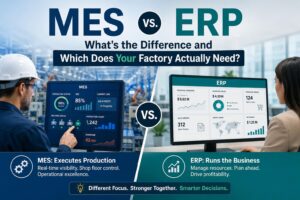
If you run a factory and someone tells you "just get an ERP," you’ve probably wondered whether that’s the whole story. And if you’ve heard of MES but aren’t sure how it’s different from SAP or Oracle — this guide is for you.
Read More
If you run a factory and someone tells you "just get an ERP," you’ve probably wondered whether that’s the whole story. And if you’ve heard of MES but aren’t sure how it’s different from SAP or Oracle — this guide is for you.
Read More
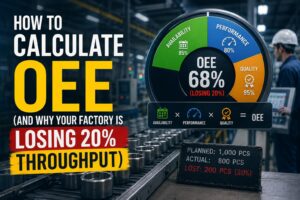
Most factory managers know their machines are running. What they don’t know is how well they’re running — and the gap between those two things is usually 20–30% of production capacity sitting quietly on the floor, unaccounted for.
Read More
If you run a factory and someone mentions "MES," you have probably nodded along while quietly wondering what it actually does — and whether you need one.
Read More
A field guide to measurement data integration for Singapore precision manufacturers, medical device makers, aerospace component suppliers, and semiconductor back-end shops.
Read More
The data source nobody wants to talk about Walk into the General Affairs department of a Japanese, Thai, or Chinese factory and ask where last month’s electricity consumption data is. You will not be directed to a system. You will be directed to a folder — physical or digital — containing PDFs from the local […]
Read More
The first time a Japanese, Thai, or Chinese conglomerate’s CFO sees a Big 4 CSRD readiness proposal, the reaction is some variant of disbelief. €2–4M for the first year. €400–900K ongoing. Hourly rates that translate to JPY 60,000–100,000, RMB 3,000–5,000, or THB 13,000–22,000 per hour. The proposal arrives with a Gantt chart, a stakeholder map, […]
Read More
The €5M quote and the wrong line item A pattern we keep seeing. A Japanese, Korean, or Thai conglomerate gets the letter — or rather, the internal memo — confirming that one of their EU subsidiaries crosses the CSRD threshold. Net turnover above €50M, more than 250 employees, listed or large enough that the Omnibus […]
Read More
War does not stay on the battlefield. Since Russia’s full-scale invasion of Ukraine in 2022, one of the most consistent targets has not been a military base or a weapons depot — it has been the power grid. Substations, gas pipelines, thermal plants, and transmission lines have been hit repeatedly by missiles, drones, and cyberattacks […]
Read More
Introduction Many companies depend on software systems that nobody fully understands anymore. The original developers may have left, documentation may be outdated, and the system has evolved through years of patches and quick fixes. Yet these systems often run critical operations such as finance, logistics, manufacturing, or customer management.
Read More
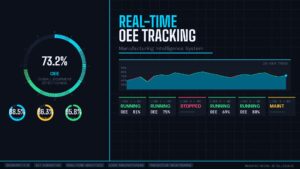
Introduction Overall Equipment Effectiveness (OEE) is the gold standard metric for measuring manufacturing productivity. Yet most factories still rely on manual data collection, end-of-shift reports, or disconnected spreadsheets — leaving managers blind to what’s happening on the floor right now. A real-time OEE tracking system changes that entirely. By capturing machine data as it happens, […]
Read More
Integrating AI into legacy systems is one of the most critical — and most underestimated — engineering challenges in enterprise digital transformation. Most AI initiatives don’t fail because of the model. They fail because the data lives in a 15-year-old SAP instance, a SCADA historian with a proprietary protocol, or an on-premise Oracle database that […]
Read More
1. The Enterprise System Problem in 2026 Modern enterprises face increasing pressure: AI disruption across industries Rising cybersecurity threats High SaaS licensing costs Vendor lock-in Slow development cycles Traditional enterprise vendors are expensive, inflexible, and closed. Many companies now realize that owning their architecture is more strategic than renting software forever.
Read More
Most factories don’t fail at MES because of technology. They fail because the system doesn’t reflect how the factory actually works. On paper, ready-made MES looks perfect: OEE dashboards Traceability Production reports Compliance checklists But on the shop floor, a different story appears: Operators keep Excel sheets “just in case” Supervisors manually adjust numbers Engineers […]
Read More
Introduction Many recycling business owners ask the same question: “How can I predict copper or steel prices so I don’t buy at the wrong time?” The honest answer is this: You don’t need perfect prediction. You need better decisions than yesterday. This article explains a practical, business-oriented approach to predicting metal prices—designed specifically for recycling […]
Read More
Introduction Many recycling companies are investing in AI technologies with the hope of improving efficiency, yield, and profitability. However, a significant number of these projects fail to deliver real business value. The primary reason is not the AI models themselves—but the lack of proper system integration. This article explains why AI initiatives in recycling often […]
Read More
When factories begin their digital transformation, one question comes up again and again: Should we design our systems using ISA-95 or RAMI 4.0? The short answer is: this is the wrong question. ISA-95 and RAMI 4.0 are not competitors. They solve different problems at different abstraction levels, and the strongest industrial architectures use both together.
Read More
For years, industrial AI discussions focused on models: accuracy, datasets, and algorithms. In 2026, that focus is shifting. The real differentiator in industrial environments is no longer which model you use, but how AI is executed reliably, efficiently, and safely inside real systems. This is where AI accelerators and software frameworks quietly redefine the market.
Read More
The POS Designed for Businesses Where Reality Matters Imagine a recycle yard on a busy morning: a truck unloads scrap metal, the operator places it on the scale, weight stabilizes, a receipt prints instantly, and payment is calculated on the spot. There is no spreadsheet, no manual typing, and no argument later about what really […]
Read More
Scrap trading keeps factories efficient and recyclers running — but if you’ve ever dealt with it directly, you know the process is often slower and more manual than it needs to be. Prices are unclear. Coordination takes time. Too much depends on phone calls and personal contacts.
Read More